Four Important Questions to Advance Reconciliation

By Larry Griffin, LaTanya Tyson, and David Fincher (The column about racial justice, equality, and reconciliation was written by three Christian college presidents. Larry Griffin serves as president of Mid-South Christian College, Memphis, Tenn.; Dr. LaTanya Tyson serves as president of Carolina Christian College, Winston-Salem, N.C.; and Dr. David Fincher serves as president of Central Christian College of the Bible, Moberly, Mo., while also leading the Association of Christian Church Colleges and Universities.) As presidents of Christian church colleges that serve the Restoration Movement, we lament the examples of injustice and division that have sadly become too commonplace in America.
Churches, Colleges Respond to George Floyd’s Death, National Discord

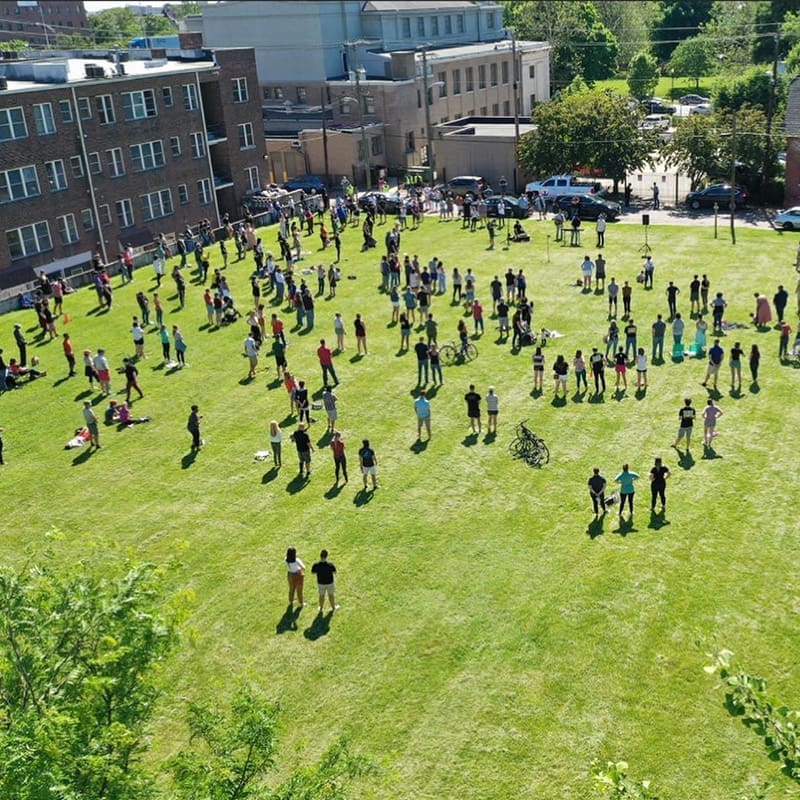
Christian churches and colleges across the country have called for prayer, dialogue, and reconciliation in response to outrage and demonstrations over George Floyd’s death while in the custody of Minneapolis police on May 25. Among the many examples: •  Dudley Rutherford, pastor of Shepherd Church, Porter Ranch, Calif., had a conversation with several leaders in the black community, most of whom attend Shepherd regularly, about topics that included Floyd, the Black Lives Matter movement, and the current state of our country. (View it at the church’s Facebook page.) • A dozen staff members of Crossroads Christian Church, Corona, Calif., spent about

Righting the Wrongs of the Past

By Jerry Harris I’m a product of the suburbs. I grew up on the west side of Indianapolis in the early 1960s, part of a post-World War II migration from urban areas to planned neighborhoods that sprang up from what were formerly farm fields surrounding big cities. There were a number of reasons for this great migration. Ex-servicemen had access to loans to pursue the American dream, so they moved out of apartments in the city and purchased their own homes on their own land in burgeoning suburbs. The availability of automobiles and creation of the interstate highway system encouraged

Pantano Recognized for Racial Reconciliation Efforts

By Jim Nieman Glen Elliott, lead pastor with Pantano Christian Church, Tucson, Ariz., represented PCC Sunday as they received the church of the year award for racial reconciliation from the Racial Reconciliation Community Outreach Network in that city. “I’m so grateful to be a part of a church that embraces racial equality & unity,” Elliott wrote on Facebook. Pantano has been working toward racial reconciliation for many years. “Back in 2013 a small group of black and white pastors agreed—some reluctantly—to meet to better understand each other and see if we could address this in our community,” Elliott shared with

Daryl Reed: Building Bridges for the Next Generation

By Melissa Wuske “I’m the grandson of a preacher,” says Daryl Reed, “so I always had it in my mind that it’d be cool one day to be a preacher.” When it came time for college, however, “I really didn’t want to go to any preaching school or seminary, because . . . I thought I was still too cool for that,” he laughs. This isn’t a story about youthful overconfidence, though; Reed was following the example of earlier generations of his family, and now he’s helping subsequent generations of young people live it. “My grandfather was a reluctant preacher,”

Building an Integrated Church

 A Minister Speaks about His Experience in Building a Multiracial Congregation   By Andy Daniell Most Restoration Movement church leaders I’ve talked to, both online and in person, say they desire to build more integrated, multiethnic congregations. They see advances in diversity in other parts of society and think their congregations are lagging behind. Bible verses such as Galatians 3:28, Colossians 3:11, and Revelation 5:9 and 7:9 suggest the church should lead in such efforts. And so it is dismaying that surveys consistently show only about 5 percent of Protestant and nondenominational congregations have a “minority” group—be it black, white,

Cloud Church: Space for Diversity, Relationship, and the Kingdom

By Mel McGowan Imagine you’re rearranging your office. You move your desk to one corner, your bookshelf to another. You move the lamps around to get the light just right. You adjust the couch so you can see your guests better. At the end of the day, you look around with satisfaction that all your office furniture, equipment, and supplies are in the right places. Why is this so important to us? Because the furnishings of our offices are tools that facilitate things like ideas, hard work, and skills. It should come as no surprise, then, that your sacred space

The Value of Another Person’s Story in Resolving Racial Conflict in the Church

“Jesus treated everyone as important, regardless of their race, ethnicity, gender, or class. Are we not to do the same?”   By Matthew McBirth As I see it, the relationship between two Jewish characters and their families in Chaim Potok’s novel The Chosen illustrates one of the primary causes of racial conflict in our communities. The plot (in short): Reuven and Danny grow up in different sects and communities, and Reuven strongly objects to how Danny’s father raises his son in virtual silence to prepare him to be his community’s next leader. When Danny and his father do speak, it’s

Racial Reconciliation: Strides in the Right Direction

By Michael C. Mack Most of us can agree on a few facts about racial prejudice, division, and conflict. It’s real. It has existed in our culture and in our churches in the past. It persists today. And it will likely  continue to be an issue for some time. Thank God, it will not exist in Heaven. I think we’d all agree it’s wrong. It’s unbiblical. It’s definitely not Christlike. Most of us know the Bible verses: Matthew 28:19; Galatians 3:28; Colossians 3:11; 1 John 4:8-11; Revelation 7:9; and others. Many of us know something I didn’t. Most Restoration Movement

Christian Standard Interview with Fred Gray: Preacher, Lawyer, and Civil Rights Warrior

By Jerry Harris HE’S A QUIET southern gentlemen, but he wields the law like a warrior. He is fueled with a deep conviction to his calling in life. Though he is nearly 88, his recall of facts and names is instantaneous. He is friendly . . . able to distinguish lines that separate the arena of ideas from the God-given value of every human being with whom he comes in contact. He’s among the last remaining champions of the earliest days of the civil rights movement; he is the one who brought the heavy weight of the law to bear

January 3, 2019

Jerry Harris

Heroes

By Jerry Harris   What are heroes? Heroes are people who stand up against insurmountable odds with little or no hope of success. They are people who refuse to give up, even when it’s contrary to the warnings of friends, loved ones, and common sense. They are people who don’t think about how they’ll be remembered, but take action in the moment because they feel the rightness of a cause . . . and the necessity of it. They risk it all for that one chance, that impossible opportunity to make the difference. They are selfless in that moment of

The State of Racial Reconciliation in the Church

An interview with Sonny Smith, lead pastor of Detroit Church   By David Dummitt In a February 1957 message for the National Council of Churches’ observance of Race Relations Sunday, Dr. Martin Luther King Jr. wrote, Racial segregation is a blatant denial of the unity which we all have in Christ. Segregation is a tragic evil that is utterly un-Christian. . . . Every Christian is confronted with the basic responsibility of working courageously for a non-segregated society. The task of conquering segregation is an inescapable must confronting the Christian Churches. King’s bold words speak to churches today as clearly

Red and Yellow, Black and White

Relentless Church Answers the Call to Create a Multiethnic Congregation in North Carolina   By Justin Horey David Jones is white. He grew up in the South, went to Bible college in the South, and married his high school sweetheart. Rafael Gonzalez is of Puerto Rican heritage. He grew up in the Northeast, excelled in high school football and basketball, and came to faith in Christ at age 28. Joy Bey is African-American. She grew up in South Central Los Angeles, was saved in a Pentecostal church, and served in overseas missions before spending five years on staff at a

Denzil Holness Spreads a Message of Racial Reconciliation

By Jacqueline J. Holness Had Denzil D. Holness been hired as a pastor in Coward, South Carolina, or Peculiar, Missouri, or any other out-of-the-way American town or city, he may not have been led to take on racial reconciliation in the Christian church. However, since Holness was hired as the first black pastor at Central Christian Church in Atlanta, Georgia, “The City Too Busy to Hate,” it would seem tackling racial reconciliation was God’s plan for him all along.   Committed to Christian Church Principles Holness became CCC’s pastor in September 1979 and in December 2017, he retired from ministry

Leading in the Direction of Unity      

By Alan Stein In the movie Hidden Figures, Kevin Costner plays Al Harrison, a mission director of NASA in April 1961 when the Soviets launched the first man into Earth’s orbit. Harrison (a composite character) had a single-minded mission: successfully launch an American into orbit and safely return him to Earth. NASA was just beginning to transition into the computer age, and so they had some uncertainty about the trajectory calculations provided by the agency’s IBM computer. Astronaut John Glenn, preparing for the Friendship 7 launch that would send him into orbit in February 1962, asked for mathematical genius Katherine

Marshall Keeble and What He Taught Me

By Jerry Harris I, like so many independent Christian church preachers, had the opportunity to study the history of the Restoration Movement in Bible college. My experience was a droning professor in a 7 a.m. class. My goal then was simply to survive it, achieve the best grade possible, and then move on to more interesting things. Biographical sketches of our movement’s pioneers held little interest for me at the time, and for the most part, it stayed that way for many years. It wasn’t until our church launched a multisite location in Hannibal, Missouri, that an interest in our

Inspiring Us to Greater Things

By Jerry Harris Last year at the North American Christian Convention, David Johnson of Harvest Point Church in North Charleston, South Carolina, stopped by the Christian Standard Media booth to talk. When I mentioned that I had been reading about Marshall Keeble, David just lit up. He began to share things he’d learned about Keeble’s methods of establishing churches and raising up leaders for them. He mentioned names of some other folks and asked if I’d heard or read about them. It was my favorite part of the convention, and it energized me for writing the article about Keeble this month.

What Kind of Extremists Will We Be?

By Michael C. Mack “If today’s church does not recapture the sacrificial spirit of the early church, it will lose its authenticity, forfeit the loyalty of millions, and be dismissed as an irrelevant social club with no meaning for the twentieth century. Every day I meet young people whose disappointment with the church has turned into outright disgust.” Dr. Martin Luther King wrote these words in his “Letter from Birmingham Jail” on April 16, 1963. Now, nearly 55 years later, his words seem prophetic. King’s letter was in response to eight white Alabama clergy members who wrote a letter asking

Reconciliation

By Jim Tune “There is neither Jew nor Greek, there is neither slave nor free, there is no male and female, for you are all one in Christ Jesus” (Galatians 3:28, English Standard Version). “All this is from God, who through Christ reconciled us to himself and gave us the ministry of reconciliation” (2 Corinthians 5:18, ESV). ___ A number of widely publicized events have many people concerned about racial tensions in America. Blacks and whites may not agree on underlying causes or potential solutions, but skin color aside, it seems no one is happy about the present state of

Love and Reconciliation

By Jim Tune On Sunday, September 15, 1963, four members of the Ku Klux Klan planted and then detonated at least 15 sticks of dynamite beneath the front steps of an African-American church in Birmingham, Alabama. The firebombing of the 16th Street Baptist Church killed four girls, prompting Martin Luther King Jr. to make one of the most radical statements imaginable: “At times life is hard, as hard as crucible steel. In spite of the darkness of this hour, we must not lose faith in our white brothers.” To insist on faith in the humanity of an enemy and to

Help Keep Christian Standard Free & Accessible with a Tax Deductible Donation

We can do more together!

Every gift makes a difference!

No, thank you.
100% secure transactions - receipts provided.
Does Your Church Want to Support Christian Standard?

Would your church consider including support for Christian Standard in its annual missions budget? Your support would help us not only continue the 160-year legacy of this unifying ministry, but also expand the free resources, cooperative opportunities, and practical guidance we provide to strengthen churches in the U.S. and around the world.

We can do more together!

Every gift makes a difference!

No, thank you.
100% secure transactions - receipts provided.
Secret Link