
By Stuart Powell
Early in World War I the British army made an amphibious landing at Suvla Bay in what is now western Turkey. The invasion was part of the August Offensive of 1915, the final attempt to break the deadlock of the Battle of Gallipoli. There are numerous descriptions of the Allied forces landing in their battle against German and Ottoman defenders.
Among those who landed was a soldier named William Henry Littlejohn. Sargent Littlejohn survived the landing, the months-long stalemate, and the Allies’ withdrawal in December 1915, but he did not survive the war. The company sergeant major of the Middlesex Regiment was killed by a German sniper at the Battle of Arras in France on April 10, 1917.
What did survive the war was Littlejohn’s account of a sacred moment on the battle-scarred shoreline of that bay far from home in August 1915. He wrote a three-stanza poem about the celebration of Communion led by a chaplain on the beach at Suvla Bay. The memory of that battlefield time of worship began with a contrast between the visible and invisible realities present that day.
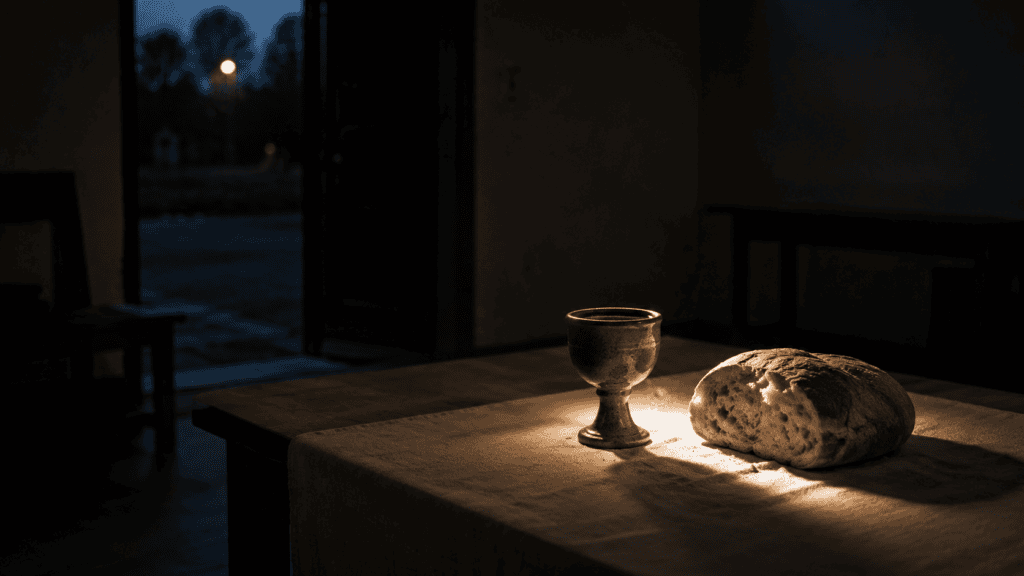
Behold a table spread!
A battered corned-beef box, a length of twine,
An altar-rail of twigs and shreds of string.
. . . For the unseen, divine,
Uncomprehended Thing
A hallowed space amid the holy dead.
In that moment, Littlejohn and his fellow soldiers stepped away from the war to remember the victory of Jesus’ sacrifice. The crude setting did not rob Littlejohn’s view of Jesus’ compassion. While he wrote about the table from a soldier’s perspective, he saw with spiritual eyes the power brought to life in the elements on that makeshift table.
Consider Jesus’ invitation to remember his sacrifice by partaking of the loaf and cup.
And he took bread, gave thanks and broke it, and gave it to them, saying, “This is my body given for you; do this in remembrance of me.” In the same way, after the supper he took the cup, saying, “This cup is the new covenant in my blood, which is poured out for you” (Luke 22:19-20).
Jesus’ call to remember made no exception for ugly circumstances or makeshift tables. He did not require an ornate setting or a quiet gathering place. Jesus wanted his disciples to focus on the memory behind the bread—an innocent body sacrificed for our sins. He wanted each follower to relive the painful price of his life blood—poured out to establish the New Covenant of God’s forgiveness.
As we partake today, let Sargent Littlejohn’s poem rekindle in you this truth: When our battles are the worst, we soldiers of the cross need to remember what Jesus did for us the most.
Stuart Powell lives outside of Terre Haute, Indiana, where he serves with the North Side Christian Church.
Read the entire poem, “Holy Communion, Suvla Bay.”

Author: Stuart Powell
Stuart Powell lives outside of Terre Haute, Indiana, where he serves with the North Side Christian Church.